Team performance / Workspace performance dashboard
Compare team members’ outreach activity, booked meetings, email response times, and reply sentiment in one report.
The Team performance dashboard helps you review and compare results within your workspace. It includes meeting records, contact enrollments, outreach activity, response times, and email reply sentiment.
To open the dashboard, go to Reports → Team performance.
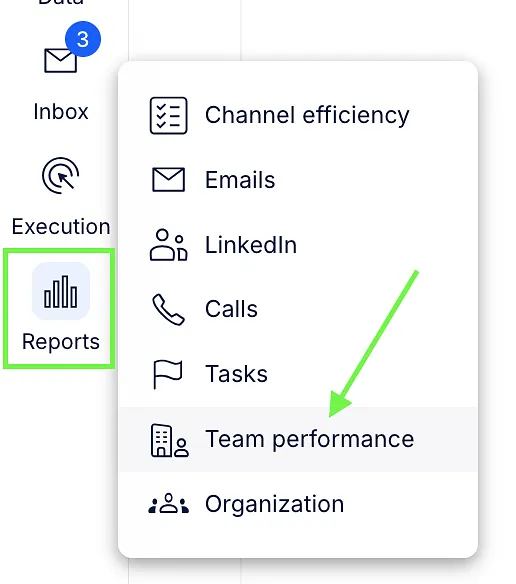
In agency accounts, this report is called Workspace performance.
Your reporting permissions determine whether you can access the report and whose results you can view.
How to use the dashboard
1. Select the reporting period and filters
Use the date range selector to choose the reporting period.
Open the filters panel to narrow the report using the available criteria:
-
Owners, sequences, and sequence steps.
-
Email accounts.
-
Contact lists and imported CSV files.
-
Contact attributes, including company, industry, location, and job title.
-
Email validation status and reply sentiment.
You can save filters and reuse them later.

💡Filters apply only to metrics they support. For example, the email-account filter does not affect Contacts Sequenced, and the reply-sentiment filter does not affect booked meetings.
2. Review the performance overview
The overview displays the main performance metrics for the selected period and applicable filters.

Booked Meetings
Shows the number of meeting records included in the report. This can include meetings recorded for contacts outside a sequence, so the total may differ from reports that require a sequence or outreach-channel association.
Meetings for contacts that were never in a sequence are not counted in the channel and agency reports, so the People page Meeting Booked filter may show more contacts.
Click Booked Meetings to view the underlying meeting records.
💡 A meeting is credited to the last step the contact completed and to that step's channel.
Contacts Sequenced
Shows the number of contact-to-sequence enrollments added during the selected reporting period.
This metric does not indicate that contacts have received outreach, are currently being processed, or belong only to active sequences. For example, adding contacts to an inactive sequence can increase this number before the sequence is launched. Pausing a sequence does not remove those enrollments from the report.
A contact added to multiple sequences can be counted more than once, so this metric does not necessarily represent unique contacts.
Meetings conversion
Shows the number of booked meetings divided by the number of contacts with recorded touches, multiplied by 100.
Meetings conversion = Booked meetings ÷ Contacts with recorded touches × 100
The calculation does not use Contacts Sequenced as its denominator. Therefore, dividing Booked Meetings by Contacts Sequenced may produce a different result.
At the workspace level, the calculation combines member-level contact counts. A contact with activity under multiple members can contribute to more than one member's count.
Touches per contact
Shows the average number of included outreach touches per contact with recorded activity.
The dashboard separates touches into:
-
Auto touches per contact: Includes sequence-email and automated-SMS records.
-
Manual touches per contact: Includes direct-email and manual-SMS records, plus qualifying completed task records. To-Do and Meeting tasks are excluded.
Total, automated, and manual touches per contact use the same denominator: contacts with recorded touches. These metrics reflect the activity included in this report, not every possible interaction with a contact.
Average response time
Shows the average recorded time taken by your team to send an email response to a contact, displayed in hours and minutes.
This metric measures your team's response time, not how long contacts take to reply. Only available, non-zero email response-time records are included. The overview value is calculated from the member-level averages that have response-time data.
3. Compare member performance
Meetings chart
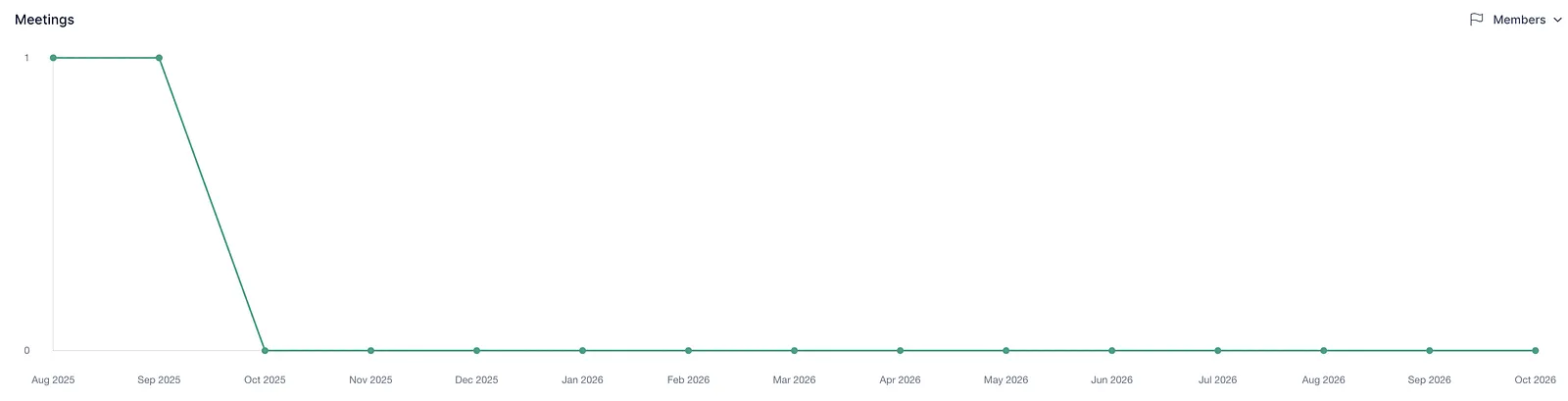
The Meetings chart shows booked-meeting results over time and lets you compare members.
-
Use the Members selector to choose which users to display.
-
Click a chart point to open the meeting records for that user and reporting interval.
Note: Meetings are grouped by their recorded booking date, not the scheduled date of the meeting.
Meetings breakdown
The breakdown table compares individual members and includes:

-
Meetings: Booked-meeting records.
-
Contacts: Contacts sequenced.
-
Conversion: Meetings conversion percentage.
-
Touches: Total touches per contact.
-
Auto: Automated touches per contact.
-
Manual: Manual touches per contact.
-
Avg time: Average email response time.
-
Score: Relative response-speed classification.
The Performance bar compares members by their booked-meeting counts.
The Score column classifies response speed as Fast, Average, or Slow relative to other members with response-time data. It is not an overall sales-performance score and does not evaluate the quality of replies or meetings.
A score may be absent when there is insufficient comparison data, such as when only one member has a recorded response time.
Click a member's meeting count to view their meeting records.
Reply sentiment
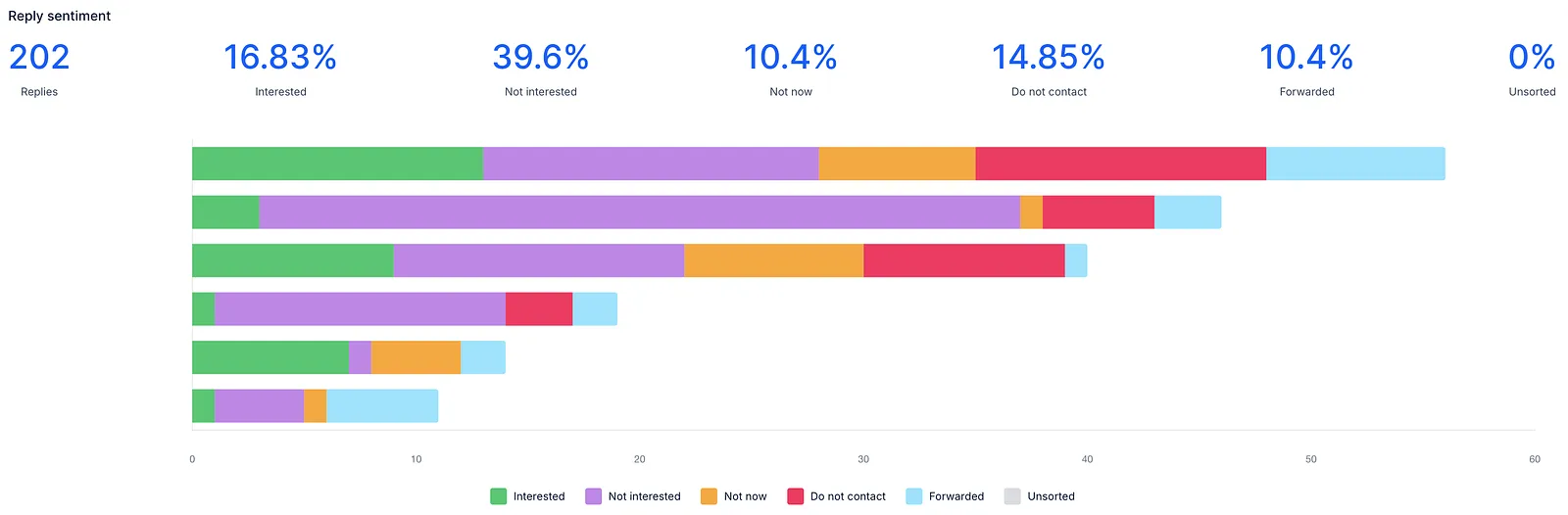
The Reply sentiment section shows email replies represented in the report, grouped into the following categories:
-
Interested
-
Not interested
-
Not now
-
Do not contact
-
Forwarded
-
Unsorted
Each category's percentage is calculated against the reported reply total. Use the chart legend to show or hide category series.
The Replies table breaks down email reply totals and sentiment categories by member. Each member's category percentages are calculated against that member's reported reply total.
💡Reply sentiment is based on email reporting. It does not combine replies across email, LinkedIn, SMS, calls, and other channels, and it does not necessarily represent unique contacts.
How the date range affects metrics
Different metrics use different dates:
-
Contacts Sequenced: The date the contact was added to a sequence.
-
Booked Meetings: The recorded booking date.
-
Touches: The relevant activity date, such as the email sent date or task completion date.
-
Sequence-email sentiment: The outgoing email's sent date.
-
Direct-email replies: The reply date.
Because the metrics use different dates, the report does not necessarily represent the same group of contacts being enrolled, contacted, replied, and booked during the selected period.
In particular, the Reply sentiment section is not necessarily a list of all replies received during the selected period.
View and export meeting records
You can open individual meeting records by clicking:
-
Booked Meetings in the overview.
-
A member's meeting count in the breakdown table.
-
A point on the Meetings chart.
The detailed view includes the owner, contact, sequence, channel, and booking date, where available.
To export meeting records:
-
Select the reporting period and applicable filters.
-
Click Export.

-
Wait for processing to finish, then use the download link in the notification.
The CSV file includes the owner, contact, sequence, channel, and date.
💡The export contains meeting records, not the complete set of dashboard metrics or reply-sentiment statistics.